In the Lary’s Speakeasy Facebook Group I see many new – and sometimes not so new – laryngectomees asking about HMEs.
This article is to answer some of those questions.
Disclaimer: I am not a doctor. I am not an SLP. I am in no way a medical professional of any kind. I am a Laryngectomee, a “Lary.” I had my total laryngectomy – “TL” – in April of 2022, so as of this writing, I am a bit over 4 years as a neck breather.
My knowledge of HMEs comes from personal experience, talking with my SLP, and discussions I’ve had with others in the Lary community, so this information is not to be used to replace medical advice you have received from a professional.
What Is An HME?
HME stands for “Heat and Moisture Exchanger.” Simply put, it is a replacement for the nose we used to use to breathe.
I’ll get into the different types of HMEs and their uses a little later in the article, but for now think of the HME as your new nose.
Why Do We Need an HME?
First, let’s start with the lungs and what they do. I promise this won’t be too boring.
Our lungs – actually our bronchial tubes – are lined with tiny hairs called “cilia.” They act as a cleaning system, constantly moving in a wave-like motion to sweep excess mucus, dust, and trapped bacteria upward toward the throat to be coughed out or for nose breathers, swallowed. I say excess mucus, as the cilia need the little goblets of mucus to help keep them flexible. Two things can stop the cilia from doing their job: Not enough mucus, and too much mucus.

Not Enough Mucus
Extremely dry air can cause the mucus in our lungs to evaporate, making the cilia hard and stiff. Thus they are unable to do their job.
Other things can cause this, such as COPD, smoking, and not enough hydration.
Too Much Mucus
As the dry air evaporates the mucus in our lungs, sometimes they go on to produce excess mucus. This can become thick and dry, blocking the cilia from moving.
Like not enough mucus, other factors can cause this as well, like inflammation, infections (like bronchitis, pneumonia, or colds), COPD, and asthma.
So both not enough and too much mucus can be a problem.
The Role Of An HME In Mucus Production
Before our laryngectomy, we had a working nose and sinuses. Their job was to warm and moisturize the air we breathed. Remember when you would be outside on a cold day, maybe doing something strenuous, and started breathing through your mouth? Your throat and lungs would get irritated and you would start coughing.
That’s what it’s like now breathing without an HME. Sucking dry, and sometimes cold air into your lungs. This can cause your mucus to dry up, and sometimes cause your lungs to produce too much.
Wearing an HME 24/7, and also staying hydrated can help prevent not enough, or too much mucus.
And if you’re in an extremely dry climate, using a humidifier can also help. I live in Atlanta, and dry air is rarely an issue. Think 75% humidity on a 90 degree day. You start to sweat just getting out of bed in the morning.
But sometimes running an A/C full time can act as a dehumidifier, so watch out there also.
The Anatomy Of An HME
Most HMEs are three parts:
- The housing
- The “button”
- The filter
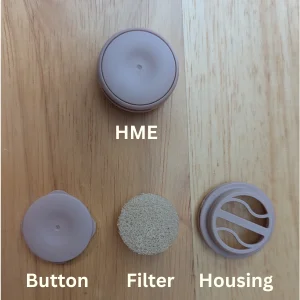
The most important part is the filter. It’s a small sponge that contains a chemical, usually calcium chloride, but different manufacturers may use different chemicals.
The calcium chloride absorbs the heat and moisture from the air we breathe out, and uses it to heat and moisturize the air we breathe in. Simple as that.
As for the other two parts, the housing is of course used to house the filter, and the button allows a TEP user to close off the airway, forcing the exhaled breath through the prosthesis. This enables them to speak. For more info on TEPs, see here.
Types Of HMEs
HMEs come in all types, for different purposes. There are two companies that manufacture HMEs, Atos Medical, and InHealth Technologies. Let’s look at the different types of HMEs offered:
Atos Medical
Atos has two different lines of HMEs, Provox (“legacy”), and Provox Life. Warning, they are not compatible with each other, as they are different diameters.
Provox Life is their most popular line. In it they have:
- Home: Designed for just being at home. High humidification with comfortable breathability.
- Go: Designed for engaging in daily activities. Slightly lower humidification and breathing resistance.
- Energy: For the more physically active. A little lower humidification and breathing resistance.
- Protect: Not just an HME, but a bacteria, virus, dust and pollen filter.
- Night: For wearing at night. The highest humidification and highest breathing resistance.
In the Provox “Legacy” line they have:
- XtraMoist: Higher humidification.
- XtraFlow: Lower breathing resistance.
- Micron: For bacteria, virus, pollen and dust filtration.
InHealth Technologies
- ClassicFlow: Designed for increased moisture retention and airflow resistance.
- EasyFlow: More porous to allow you to breathe more freely to match your activity level.
Note: Both InHealth HMEs are approved for day/night use.
InHealth HMEs are the same diameter as Provox “Legacy.”
Hands Free HME
In addition, both companies offer a hands free HME to allow someone with a TEP to be able to talk without pushing the button. I’ll do another article on those at a later date.
Bottom Line
The bottom line is: Pick the HMEs that work best for you and use them. While some people like to use multiple types (Home when they’re just sitting around, Go when they’re go outside, Energy at the gym, Protect when they’re doing yard work, and Night while sleeping), you may do best to pick one or two that fits your lifestyle. Personally, I use the Go 24/7 and sometimes the hands free. But your mileage may differ. Your SLP should be able to provide you with samples to try.
The combination of the correct HME and good hydration will make your lungs happy.
Larry is a board member, website and social media manager for Lary’s Speakeasy.
He also operates two blogs, Larry In Atlanta, which is mainly personal observations, and The Tech Boomer, which offers tech advice to seniors.
Larry and his wife, Denise live in the southern Metro Atlanta area. He had his laryngectomy in April, 2022.

Thank you Larry for the HME information it is always good to get a refresher. My husband Nick had his Laryngectomee surgery at Moffitt Cancer Center Tampa, Fl in 2009. We live in South Carolina, and our SLP is in Greenville.